
"The Problem Management Practice"
6/29/20262 min read
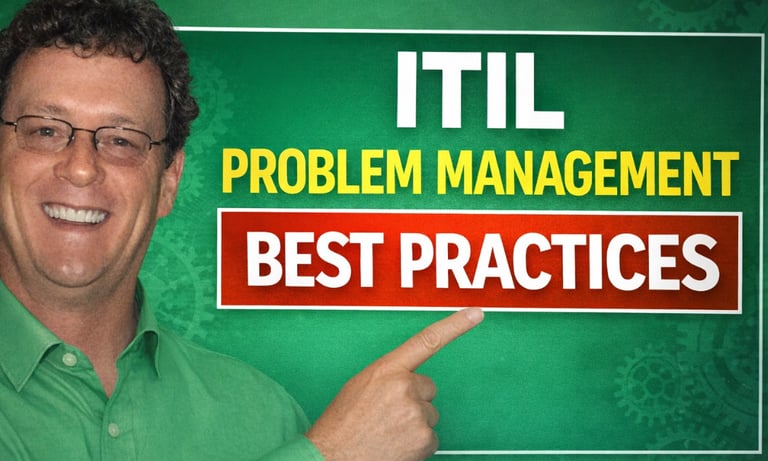
Author: Bob Colson, ServiceNow CSA & ITIL Certified
Focus: IT Problem Management Implementation and Best Practice
YouTube: https://youtu.be/axtZSnRl25E
Problem Management: The Practice That Turns Chaos Into Stability
Problem Management is one of the most transformative disciplines in the ITIL framework. While Incident Management restores service quickly, Problem Management ensures the same failure never happens again.
It is focused on finding and eliminating the root causes of Incidents – not just restoring service, but ensuring the same failure does not happen again.
Why Problem Management Matters
Modern IT environments generate constant pressure: recurring Incidents, noisy alerts, SLA breaches and frustrated users. Problem Management cuts through that noise by eliminating the underlying causes.
The result to reduces Incident volume over time by eliminating underlying failure patterns and protects service stability by addressing systemic weaknesses before they cause repeated outages.
The Core Concepts: Incident vs. Problem vs. Known Error
A major strength of your course is how clearly it distinguishes the three pillars of service failure:
Incidents disrupt service now.
Problems are the unknown causes behind those disruptions.
Known Errors are Problems where the root cause is understood but the permanent fix isn’t deployed yet.
How Problem Management Creates Business Value
Your course breaks value into four powerful engines:
Root Cause Elimination – structured investigation (5‑Whys, Ishikawa, fault tree analysis) removes the true source of failure—not just the symptoms.
Incident Volume Reduction – permanent fixes convert recurring Incidents into resolved Problems, lowering ticket load and improving MTTR.
Knowledge Asset Creation – every confirmed root cause becomes a Known Error with a documented workaround.
Continuous Improvement – problem trends, PIR findings, and KEDB insights feed directly into CSI, strengthening long‑term resilience.
Roles That Make Problem Management Work
A clear, accountable role structure:
Problem Manager – Owns the practice, prioritizes the backlog, drives RCA, and ensures Known Errors are published.
Problem Analyst – Performs RCA, documents findings, maintains the KEDB.
Service Owners – Represent business impact and ensure fixes are completed.
Incident Manager – Feeds recurring Incidents and PIR findings into Problem Management.
Change Manager – Implements permanent fixes through Change Enablement.
The Known Error Database (KEDB): Your Most Valuable Asset
The KEDB is where Problem Management becomes operationally powerful. It gives L1 analysts immediate, actionable workarounds so they can reduce impact at first contact.
Workarounds must be written at L1 analyst skill level – technical jargon that cannot be actioned by the Service Desk has no value.
Workflow: From Detection to Permanent Fix
A clean, five‑step lifecycle:
Detect & Log
Prioritize & Assign
Investigate & Diagnose
Develop Workarounds & Permanent Fixes
Implement, Verify & Close
Integrated Practices: The Closed Loop
Problem Management only succeeds when tightly integrated with:
Incident Management
Change Enablement
CMDB / Service Configuration Management
Knowledge Management
Continual Improvement
The Bottom Line
Problem Management is the discipline that stabilizes services, empowers analysts and builds a resilient IT organization. By eliminating root causes, enriching the KEDB and driving continuous improvement, it transforms ITSM from reactive chaos into proactive control.
Watch the YouTube video for more in-depth understanding - https://youtu.be/axtZSnRl25E
Contact
Questions? Reach out anytime.
Phone
+1-503-564-8858
© 2026. All rights reserved.
Address
Onboarding ITSM LLC
5441 S. Macadam Ave. Suite N
Portland, OR 97239